20 Best Ideas For Choosing AI Stock Investing Platform Websites
Top 10 Tips On Assessing The Integration And Compatibility Of Ai Predictive/Analyzing Trading Platforms
Integrity and compatibility are crucial elements when it comes to the evaluation of AI stock predicting/analyzing trading platforms. Platforms that seamlessly integrate with the existing workflows, tools and systems can boost efficiency and effectiveness. Here are 10 best tips to help you evaluate the compatibility and integration of these platforms.
1. Check Brokerage Integration
Ensure that your platform integrates seamlessly with the brokerage or trading service you would like to use.
Trade execution: Find out whether your platform permits the execution of trades directly with an integrated broker.
Account synchronization: Check to see if the platform you are using is capable of syncing account balances, transactions, and positions in real-time.
2. Examine API for Availability
API access is crucial Developers can utilize an API, or Application Programming Interface (API), to build their own software and automate processes.
API documentation: Verify that the documentation for the API has clear examples with examples of use.
Rate limits: Make sure that the API has reasonable limits on rates that are able to handle the amount of use you anticipate.
3. Assess Third-Party Tool Integration
Popular Tools: Make sure the platform has integrations with other tools, such as Google Sheets and Excel.
Export and import of data. Make sure your platform can import and export data easily from other tools.
Plugins/extensions: Verify if the platform supports extensions or plugins for further features.
4. Test Compatibility with Operating Systems
Desktop compatibility: Ensure that the platform is compatible with your operating system of choice (Windows, macOS or Linux).
Mobile compatibility – Check to see if your platform comes with a mobile version that is compatible with iOS and Android.
Web-based: If you want to be flexible, make sure you check if your platform can also be accessed via a standard web browser.
5. Evaluating Data Integrity Capabilities
Data sources: Make sure the platform can integrate with different data sources (e.g. market data sources, news feeds, social media sentiment).
Real-time analytics: Ensure that the platform integrates real-time analyses.
Import historical data: Check whether the platform supports the import of historical data to analyze or backtest.
6. Check cloud and on-premise compatibility
Cloud-based platform: Accessible anywhere with an Internet connection.
On-premises deployment: Make sure you know the platform you’re using allows deployment on premises.
Hybrid models: Check if the platform combines cloud-based and on premise capabilities.
7. Make sure to check for Cross Platform Synchronization
Device synchronization: Make sure that your platform syncs data and settings across devices (desktop tablet, mobile).
Real-time updates: See if your changes made on one device instantly show up on other devices.
Offline access – Check whether you have access to information or have limited access to functions in the event that the platform isn’t online.
8. Verify the whether trading strategies are compatible
Algorithmic trading – Make sure that the trading platform you select supports automated or algorithms trading strategies.
Custom indicators: Find out whether you are able to make use of custom indicators or scripts.
Strategy backtesting. Find out if the platform supports strategies that are tested back using historical data.
9. Review Security and Compliance
Data encryption: Ensure that the platform uses encryption both for data in transit and at rest.
Authentication : Make sure that the platform supports secure authentication methods (e.g. two-factor verification).
Regulative Compliance: Determine if your platform is compliant with the applicable regulations.
10. Test Scalability and Performance
Scalability: The platform should be able accommodate growing user numbers and data volumes.
Performance under load – Verify that the platform continues to respond in conditions of high market volatility.
Utilization of resources: Ensure that your platform makes the most efficient use of system resources such as CPU, memory and bandwidth.
Bonus Tips:
Feedback from customers: Read user reviews and testimonials in order to determine the capabilities to integrate the platform.
Trial period: Make use of a no-cost trial or demo to discover how the platform works with other tools and processes.
Customer support: Ensure your platform has a robust assistance for integration-related problems.
These suggestions will assist you to assess the compatibility and integration capabilities of AI analysis and stock prediction platforms. This will help ensure that they are compatible with your current systems and increase the efficiency of your trading. Read the best ai for investment info for more recommendations including trading ai, trading with ai, investing ai, ai for investing, ai investment app, best ai trading app, chart ai trading assistant, ai for investing, using ai to trade stocks, best ai for trading and more.
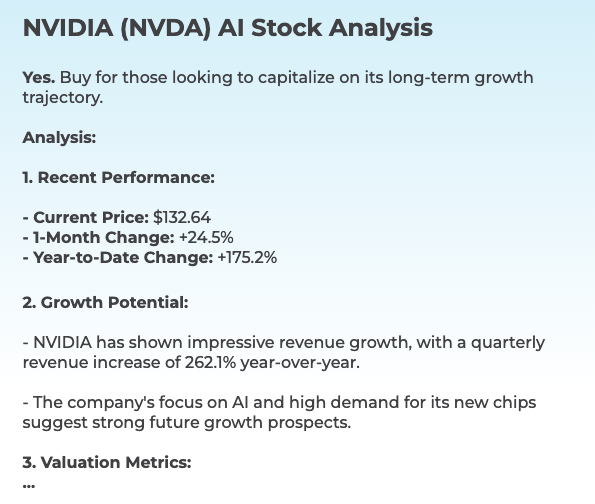
Top 10 Tips To Assess The Transparency Of Ai Stock Predicting Trading Platforms
Transparency is an important factor when looking at AI platforms for prediction and trading in stocks. Transparency allows users to verify predictions, trust the platform and understand the way it functions. Here are the top 10 ways to gauge the level of transparency in these platforms.
1. AI Models explained in depth
TIP: Make sure that the platform provides information on AI models and algorithms that are used to predict.
Why: By understanding the technology, users are able to determine its reliability and limitations.
2. Disclosure of Data Source
Tip
Why? Knowing the sources of data ensures that the platform uses reliable and accurate information.
3. Performance Metrics and Backtesting Results
TIP: Look for transparent reporting regarding the performance metrics like accuracy rate, ROI and backtesting.
This gives users the ability to compare past performance against the latest platform.
4. Real-time notifications and updates
TIP: See if you are receiving real-time alerts as well as updates regarding trading, predictions or other changes to the system.
Why: Real-time transparency ensures that users are informed at all times about crucial actions.
5. Transparent Communication on Limitations
Tip – Check to see whether the platform is transparent about the risks associated with its trading and prediction strategies.
What is the reason? Recognizing limitations helps build trust, and allows users to make informed decisions.
6. Users are able to access the raw data
Tip: Check if users have access to raw data, or even intermediate results used by AI models.
Why is this: Raw data can be used to verify the predictions of others and to conduct an analysis.
7. Transparency of Fees and Costs
Tip: Ensure the platform clearly outlines all fees, subscription costs, and potential hidden charges.
Transparent Pricing: It creates trust by preventing unexpected costs.
8. Regular Reporting and Audits
Find out if the platform produces regular reports or goes through audits by third parties to verify its effectiveness.
Why independent verification is important: It increases the credibility of your business and increases accountability.
9. Predictions and Explainability
Tip Check to see whether there is an explanation of how the platform makes specific predictions and suggestions (e.g., feature priority or decision trees).
The reason: Explainability helps users to comprehend AI decisions.
10. Customer Feedback Channels, Support and User Feedback
TIP: Find out if the platform has open channels to get feedback from users and offers support. It is also important to determine if it addresses user concerns in a clear and transparent manner.
Why: Responsive communications demonstrate the commitment to the transparency of communications and satisfaction of users.
Bonus Tip: Regulatory Compliance
Ensure the platform complies with the relevant financial regulations and discloses its compliance status. It adds an additional layer of credibility and transparency.
Through a thorough examination of these factors, you can determine whether an AI trading and stock prediction platform operates in a transparent manner, allowing you to make informed choices and build confidence in the capabilities of AI. Take a look at the recommended full report on ai trading tool for more info including chart analysis ai, chart ai trading, best ai stocks to buy now, ai in stock market, free ai tool for stock market india, ai for trading stocks, invest ai, ai investment tools, how to use ai for copyright trading, chart ai trading and more.
